
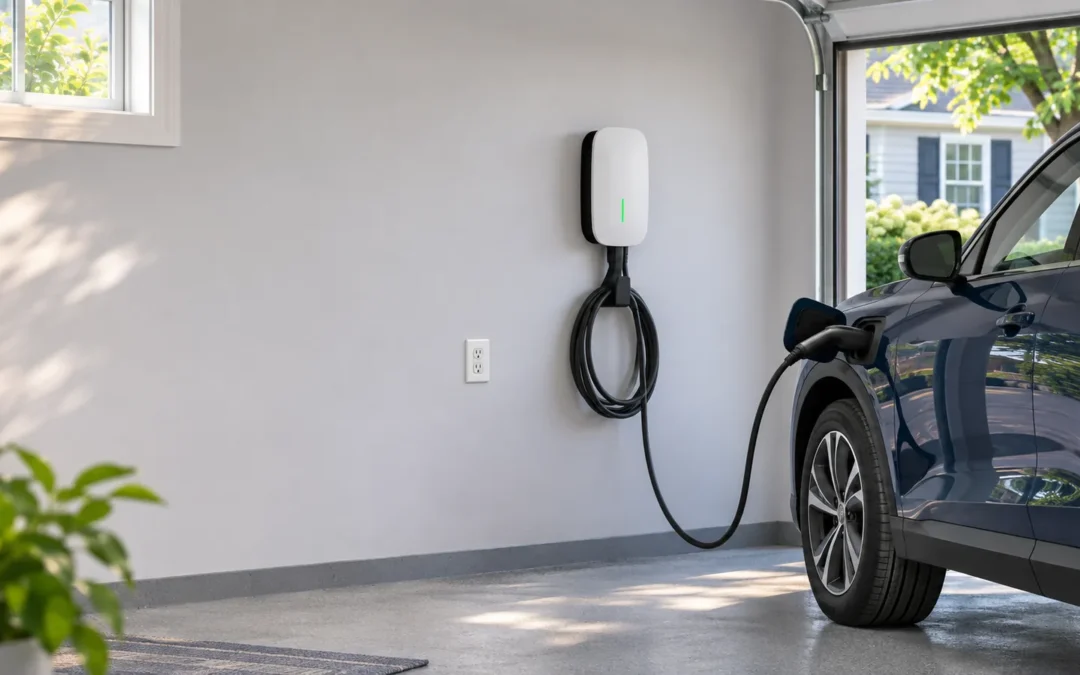
Most EV owners charge at home overnight. The practical question is how much energy the vehicle needs before the next trip, not how quickly it could charge under perfect conditions.
Quick answer: Level 1 uses a 120-volt source and may cover modest daily driving when the vehicle is parked for long periods. Level 2 uses 240-volt equipment for faster charging but requires a suitable circuit, capacity review, code-compliant installation, and properly rated equipment.
When Level 1 may be enough
Level 1 can be a reasonable starting point for a plug-in hybrid, a short commute, a vehicle that sits overnight for many hours, or a household with access to workplace or public charging.
The receptacle and circuit still matter. An older, loose, damaged, shared, or heavily loaded receptacle is not a good assumption for continuous vehicle charging. A qualified electrician can evaluate the circuit and parking location.
Why homeowners choose Level 2
Level 2 is commonly selected for longer commutes, larger vehicle batteries, irregular schedules, multiple EVs, or faster overnight recovery. The equipment may be plug-connected or hardwired depending on the installation and manufacturer instructions.
The charger’s maximum setting does not mean the home or vehicle must use that full rate. Some equipment can be configured for a lower circuit rating or controlled through listed energy-management equipment. The design should match the vehicle, travel pattern, electrical system, and future plans.
What an electrician checks
- Existing service and panel capacity
- Available breaker space and load calculation
- Circuit length and wiring route
- Garage or outdoor equipment location
- Wet-location and cold-weather ratings where applicable
- Protection and disconnecting requirements
- Charger instructions and safety certification
- Local permit and inspection requirements
- Wi-Fi or network needs for smart charging
- Utility rate or managed-charging programs
Do you automatically need a panel upgrade?
No. Adding an EV charger does not automatically require a 200-amp service. The electrician should perform the appropriate load calculation and assess the existing equipment. A lower charger setting, different circuit size, listed load-management device, or scheduling strategy may solve the real constraint.
Plan for the next vehicle
If walls are open during construction or remodeling, consider conduit routes, panel space, parking locations, and future two-vehicle charging. A modest amount of planning now can prevent expensive finished-wall work later.
Lydon Electric & Solar installs and evaluates home EV charging in Sparta, La Crosse, Tomah, West Salem, and nearby Western Wisconsin communities.
Request an EV charging evaluation or read whether your panel may need an upgrade.